-
1. What does "SOS paper bags sourcing" actually cover?
-
2. How do I tell a real kraft paper bag factory from a middleman?
-
3. What's the actual cost per bag at different volumes?
-
4. What MOQs should I expect from a kraft paper bags manufacturer?
-
5. What hidden costs show up outside the quoted unit price?
-
6. How long does sourcing, production, and delivery really take?
-
7. Is rush production worth the premium?
-
8. What should go into an RFQ to get comparable quotes?
Every quarter someone on my team asks me to "just find a cheaper paper bag supplier." And every quarter I have to explain why the cheapest quote has cost us more than it saved. I've managed our packaging budget—roughly $180,000 a year, spread across six years and more than 40 vendors—and the things I've learned about SOS paper bags sourcing rarely match what the sales pages promise.
This is the FAQ I wish someone had handed me in 2019, when I first started chasing quotes for custom-designed kraft paper bags. The questions are in the order we usually hit them: verifying the supplier, understanding the real cost, and managing deadline risk. Price ranges I cite were collected in Q1 2025 from factory quotes and public listings; verify current numbers before you put them in a budget.
What's covered:
- What "SOS paper bags sourcing" actually involves
- How to tell a kraft paper bag factory from a middleman
- Real cost per bag at different volumes
- MOQs you should expect
- Hidden fees outside the unit price
- Realistic lead times
- Whether rush production is worth it
- What to put in an RFQ
1. What does "SOS paper bags sourcing" actually cover?
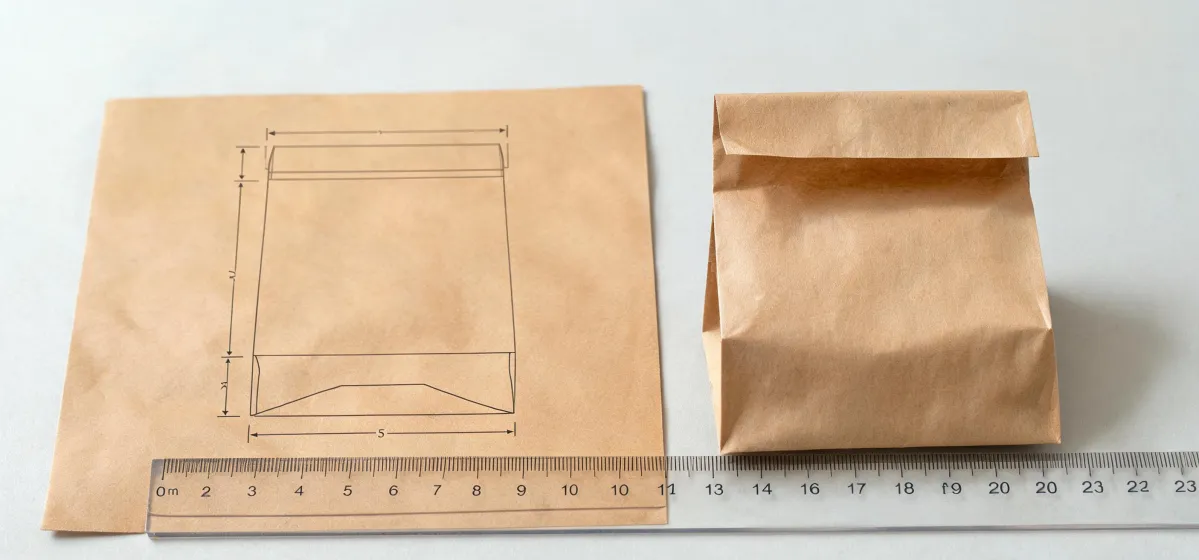
SOS stands for "self-opening sack"—the flat-bottomed paper bag that pops open when you load it. When buyers say sos paper bags, they usually mean the kraft bag you see at bakeries, delis, and retail counters. Sourcing it is not one decision. It's a stack: paper grade (GSM and virgin vs. recycled content), bag size, printing (flexo vs. offset, number of colors), handle type (none, twisted paper, die-cut), and any certification you need for your market.
Here's the part that surprises people: "custom-designed" usually means you're paying for a printing plate or die, not for a completely new bag structure. Most factories run standard SOS templates and customize the print and size. If a supplier quotes you a "fully custom structure" at standard pricing, that's a red flag—tooling for a new bag shape is a real cost.
2. How do I tell a real kraft paper bag factory from a middleman?
Ask for a video call, then ask them to walk the camera past the bag-making machines. Trading companies will schedule the call from an office and "check with the factory" for everything. That's not automatically bad—but you should know which one you're paying.
What most people don't realize is the markup isn't the only difference. A good trading company can actually be cheaper for small orders because they consolidate production across several factories and absorb the MOQ risk. My experience—about 35 custom bag orders since 2019—was that under roughly 10,000 units, the 8–12% commission a decent trading company charges often cost less than the setup and minimum-run penalties a factory quoted us directly. Above that volume, the math flips.
A verification checklist that has actually worked for me: business license matching the company name, a recent production schedule (not a brochure), and at least two customer references in your region who will take a call. If they can't produce all three, treat the "direct factory" claim as marketing until proven otherwise (note to self: I've been burned by exactly this twice).
3. What's the actual cost per bag at different volumes?
Rough ranges from quotes we collected in Q1 2025 for standard kraft SOS bags, FOB, shipping excluded:
- 5,000 units, no print, standard size: about $0.07–0.12 per bag
- 10,000 units, 1–2 color print: about $0.10–0.18 per bag
- 50,000 units, 1–2 color print: about $0.06–0.11 per bag
- Heavier GSM, die-cut handle, larger size: add roughly $0.03–0.08 per bag
Those ranges were accurate as of Q1 2025 for Asian factory-direct orders. Paper prices move with pulp and energy costs, so verify current quotes before you commit a budget line.
But the unit price is where the trap is. My first year, I compared vendors on price per bag and picked one that came in 11% cheaper. Then the invoice arrived with a $180 plate fee, a $90 "color matching" charge, and a 3% surcharge for paying by transfer instead of letter of credit. The "cheaper" option landed within 2% of the other quote—after I'd already signed.
4. What MOQs should I expect from a kraft paper bags manufacturer?
For custom print, most factories we've worked with quote a minimum around 5,000–10,000 pieces per design. Below 5,000, setup costs dominate and the per-unit price stops making sense for both sides.
There's usually room to negotiate the MOQ, but the trade is real: cut the run, and you pay a low-volume surcharge that's often close to what the extra units would have cost anyway. The better move is to combine sizes or SKUs into one production run so total volume clears the threshold without over-ordering any single SKU. We did this in 2022—four bag sizes, one order—and got factory MOQ pricing while keeping inventory manageable.
5. What hidden costs show up outside the quoted unit price?
Almost every custom bag quote I've seen omits at least one of these:
- Printing plates or die-cut tooling: $50–$300 per design, one-time
- Sample and proof fees: $30–$120, sometimes credited against the bulk order
- Pantone color-matching: $25–$75 per color
- Export packaging and palletizing: $0.01–0.03 per bag
- Third-party inspection: $100–$300 per lot if you're not visiting yourself
Here's something vendors won't tell you: the "free sample" is rarely free once you need it printed and shipped. A plain structural sample might be complimentary; a printed proof usually isn't. Budget for three sample rounds on a first order—yes, three—because print color drifts between rounds more often than anyone admits.
6. How long does sourcing, production, and delivery really take?
Not "usually"—here's the actual breakdown from an order we placed in Q3 2024 for roughly 30,000 printed SOS bags:
- RFQ to signed PO: 9 days (3 vendors, one round of revisions)
- Pre-production sample approval: 12 days (2 rounds)
- Bulk production: 18 days
- Inland plus ocean freight to our warehouse: 34 days
Door-to-door total: about 73 days. Production itself was less than a third of the timeline. When a factory says it "has a 20-day lead time," it's quoting the production window and leaving the rest in a fine-print footnote. If your deadline is fixed, build the whole chain into your schedule, not just the production block.
7. Is rush production worth the premium?
In most cases, yes—when the deadline is real. Let me be precise about what a rush fee buys: it's not just speed, it's certainty. A factory that can commit to a compressed schedule has already confirmed machine time, paper stock, and finishing capacity. You're paying for that confirmation.
In March 2024, we paid about $400 extra for expedited production on 8,000 branded bags. The alternative was missing a client event with a $15,000 budget attached to it. The $400 was not a close call.
The flip side: I've also paid rush fees on orders where nobody could tell me the actual consequence of being a week late. That was money we didn't need to spend. Before you approve a rush premium, ask the only question that matters—what does one week of delay actually cost us? If no one can put a number on it, the standard timeline is probably fine.
8. What should go into an RFQ to get comparable quotes?
This is the counterintuitive one. Most buyers think comparing quotes is about price. It's really about specifications. If your RFQ leaves anything vague, each kraft paper bags manufacturer will fill the gap differently and the quotes won't be comparable—so you end up picking on the lowest number, which is the least reliable signal in the whole process.
What we now put in every paper bag RFQ:
- Exact bag dimensions (opening, height, bottom gusset) in mm
- Paper grade in GSM and recycled-content preference
- Print: colors, Pantone references, and which side
- Handle type and attachment method
- Target quantity and acceptable MOQ range
- Delivery window and destination port or warehouse
- Required certifications, stated as "must provide documentation"
That certification line matters more than it used to. If a supplier says "food-grade" or "biodegradable," ask for the test report, not the adjective. We've had quotes fail that check—bags destined for the wrong market with claims nobody could document. That's not a savings problem; it's a compliance problem, and it comes out of a different budget.